
Your website is slow. And it's costing you money.
We're not talking pocket change here. Every extra second your site takes to load is like watching potential customers walk out of your store before they even see what you're selling. In 2026, speed isn't just a nice-to-have: it's the difference between thriving and barely surviving online.
The Brutal Truth About Speed and Sales
Here's the thing nobody wants to hear: Google doesn't care about your excuses. Core Web Vitals are now the #1 ranking factor, which means your slow website is getting buried while your faster competitors are stealing your traffic. It's a vicious cycle: poor speed leads to worse rankings, which leads to fewer visitors, which leads to lost revenue.
The data backs this up. Businesses that actually bothered to optimize their site speed saw bounce rates drop by 40% and sales jump by 25%. That's not a typo. A quarter more revenue just from making their site faster.
Think about your own browsing habits. When was the last time you patiently waited for a slow website to load? Exactly. Your customers aren't any different.
The Three Metrics That Actually Matter
Google has made this pretty straightforward with Core Web Vitals. Focus on these three, and you'll be ahead of 80% of businesses still figuring this out:
Largest Contentful Paint (LCP): This measures how long it takes for your main content to load. You need to hit under 2.5 seconds. Anything over that, and you're bleeding visitors.
First Input Delay (FID): When someone clicks a button on your site, how long does it take to respond? Laggy interactions frustrate users and trigger Google penalties. Keep this under 100 milliseconds.
Cumulative Layout Shift (CLS): Ever tried clicking a button, only to have the page shift and you accidentally click an ad instead? That's CLS, and it's infuriating. Keep your layout stable as it loads.
These aren't arbitrary numbers. Google uses them as strict ranking tiebreakers. Two similar websites competing for the same keyword? The faster one wins.
Quick Wins You Can Implement This Week
Let's get practical. Here are the changes that give you the biggest bang for your buck:
Images Are Your Biggest Problem (And Easiest Fix)
Images typically account for 50-70% of your page weight. Converting to modern formats like WebP or AVIF can cut your image sizes in half. That's instant performance improvement with minimal effort.
Implement lazy loading so images only load as visitors scroll down. Why load images that are below the fold when most visitors never scroll that far anyway?
And for the love of all that's holy, stop uploading 5MB images from your phone. Compress them first. Your hosting provider is crying.
Caching Isn't Optional Anymore
If you're not using caching, you're making your server work way harder than it needs to. Full-page caching through Cloudflare or a quality caching plugin means your site serves pre-built pages instead of generating them from scratch every single time.
Browser caching tells visitors' browsers to store certain files locally, so they don't have to download everything again on their next visit. It's free speed.
Clean Up Your Code
Every plugin you installed and forgot about? It's slowing you down. Delete unused plugins and themes. Minify your CSS and JavaScript files to remove unnecessary spaces and comments. Use defer attributes for non-critical scripts so they don't block your page from rendering.
Think of your website like your garage. The more junk you accumulate, the harder it is to find what you need.
Advanced Strategies for Serious Performance Gains
Once you've knocked out the basics, here's where you can really pull ahead:
Edge Computing and Modern CDNs
Content delivery networks have evolved. Modern CDNs don't just store your static files: they execute server-side logic at edge locations worldwide. This means sub-100ms response times no matter where your visitors are located.
Your visitor in Tokyo gets the same lightning-fast experience as someone in New York. That's the power of edge computing.

Resource Prioritization
Browsers need to make split-second decisions about what to load first. Help them out with priority hints. Mark critical resources as high priority and less important elements as low priority.
But here's the catch: over-prioritizing is just as bad as under-prioritizing. Focus on truly critical resources like hero images and above-the-fold CSS. Everything else can wait.
Mobile-First Is Non-Negotiable
Google indexes mobile versions first. If your mobile experience is slow, you're toast. Design simple layouts for mobile. Make buttons at least 48×48 pixels so people can actually tap them without fat-fingering the wrong link. Use readable fonts: minimum 16px. Serve smaller images to mobile devices.
Your desktop site can be beautiful, but if your mobile site is garbage, none of it matters.
The Islands Architecture Approach
For JavaScript-heavy sites, consider hydrating only interactive components instead of entire page structures. Keep static content as plain HTML. This dramatically reduces JavaScript execution time.
Think of it like this: only turn on the lights in the rooms you're actually using.
Making Performance an Ongoing Practice
Here's where most businesses fail: they optimize once and then forget about it. Performance optimization isn't a one-time project. It's an ongoing commitment.
Track your metrics weekly. Run automated reports. Do monthly deep dives into trends. Plan quarterly strategic improvements.
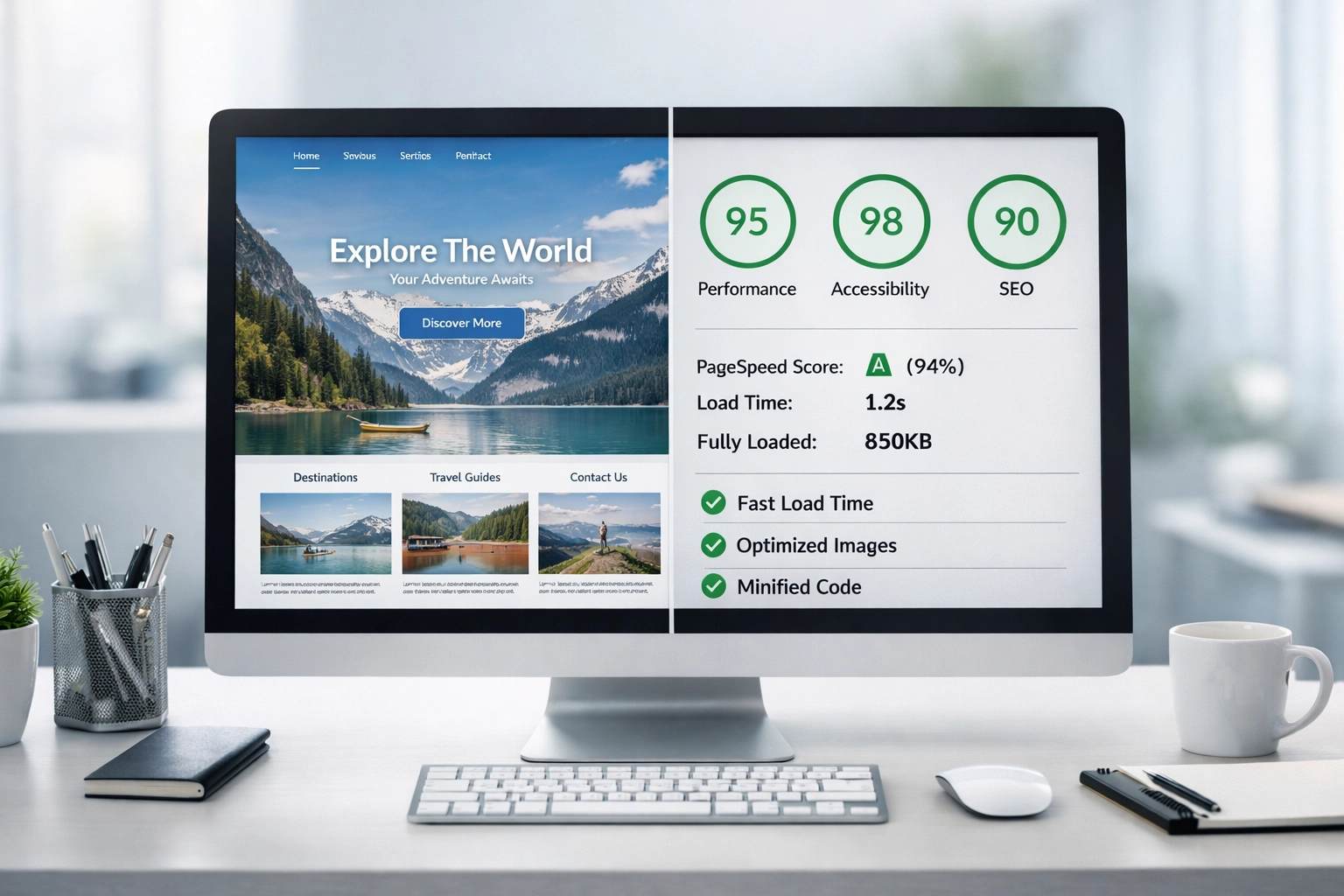
Start by testing your current performance in Google PageSpeed Insights. It'll tell you exactly what's killing your speed. Usually, it's images and caching. Fix those first, then move on to the more technical stuff.
The ROI of Speed
Every millisecond of improvement translates directly to better search rankings, happier customers, and increased revenue. We're not exaggerating. Studies show that even a 100-millisecond delay can cost you conversions.
Think about that. One-tenth of a second. That's how fine the margins are in 2026.
Your competitors are optimizing their sites right now. They're implementing these strategies, gaining speed advantages, climbing search rankings, and stealing your customers. The question isn't whether you can afford to optimize your site performance.
The question is: can you afford not to?
Speed doesn't just kill sales: lack of speed does. The faster website wins. The faster website gets the clicks. The faster website makes the sales.
Make yours the faster website.
Want help optimizing your site performance and boosting your overall visibility? Check out our visibility solutions designed specifically for businesses ready to dominate their local market.